
The fashion industry has always been synonymous with creativity, but as we step into 2025, a powerful new collaborator is reshaping the design landscape: Artificial Intelligence (AI). AI Fashion Design is no longer a futuristic concept; it’s a present-day reality that is fundamentally altering how clothing is conceived, designed, and produced.
This comprehensive guide explores the current state of AI Fashion Design, the essential tools available, key trends, and how designers can integrate AI into their creative workflow.
What Is AI Fashion Design?
AI fashion design is the use of artificial intelligence technologies—like machine learning, computer vision, and generative design—to assist or automate parts of the fashion creation process. Instead of starting from a blank sketchpad, designers can now collaborate with AI systems that generate new silhouettes, predict trends, or even simulate materials in 3D.
Common AI applications in fashion design include:
- Generative AI tools that create design concepts and color palettes.
- AI pattern-making systems that optimize fabric usage.
- Trend prediction algorithms that analyze global data to forecast what’s next.
- Virtual design studios that visualize outfits in real time.
AI doesn’t replace human creativity—it amplifies it. Designers gain more time for storytelling and innovation while AI handles repetitive or data-heavy tasks.
How AI Is Transforming Fashion Design in 2025
The year 2025 marks a critical inflection point where Artificial Intelligence (AI) ceases to be a novelty and becomes foundational to the creative and commercial success of the fashion industry. The transformation is defined by five synergistic shifts:
1. Data-Driven Creativity and Trend Mastery
AI acts as a tireless trend forecasting engine, analyzing massive, siloed datasets—from global runway archives and social media sentiment to minute-by-minute sales and search queries. This capability allows designers to move beyond mere intuition; they gain predictive mastery.
AI identifies emerging aesthetics and consumer desires with precision, ensuring that creative collections resonate powerfully with the market upon launch, minimizing commercial risk.
2. Radical Acceleration of Design Cycles
Design cycles that once took months can now happen in days. AI tools can instantly create dozens of mood board variations, sketch silhouettes, and even simulate how fabrics behave in motion.
This doesn’t just save time; it allows brands to react quickly to cultural shifts. Whether it’s a viral TikTok aesthetic or a new seasonal trend, designers can turn concepts into visuals in hours using AI outfit generators like Fashion Diffusion.
For independent creators or small labels, this speed levels the playing field—enabling them to compete with larger brands that once dominated production timelines.
3. Hyper-Personalization at Scale
AI fashion design is making mass personalization a reality. Instead of designing for general demographics, brands can design for individuals.
By analyzing a user’s preferences, purchase history, or body measurements, AI can generate personalized outfit recommendations or even custom clothing designs. This bridges the gap between creative vision and consumer demand—delivering pieces that feel uniquely “you.”
It also strengthens brand loyalty. When customers feel that a design understands their style, they’re far more likely to engage, purchase, and advocate for the brand.
4. Mandating Sustainable Innovation
AI serves as the industry’s most powerful ally in addressing the global sustainability crisis. It drives efficiency by optimizing fabric cutting patterns to achieve zero-waste layouts and streamlines supply chains to minimize carbon emissions. Furthermore, sophisticated generative models can simulate new, eco-friendly materials and rigorously test their durability and performance digitally, moving the industry toward a truly circular design process.
5. The Rise of Phygital Fashion and Virtual Commerce
Through AI outfit generators and increasingly accurate Virtual Try-On (VTO) experiences, customers can preview designs on personalized 3D avatars before making a physical purchase. This innovation significantly lowers return rates and aligns with the massive growth of digital fashion as a viable product category within gaming, Augmented Reality (AR), and metaverse ecosystems, blurring the lines between physical and virtual apparel.
Top AI Fashion Design Tools in 2025
The ecosystem of AI fashion tools is growing rapidly. Below are some of the most promising platforms in 2025 that empower designers and brands to innovate faster and smarter:
| Tool | Core Feature / Strength | Best For / Use Case |
| Fashion Diffusion | Text/sketch to photorealistic design visuals, virtual try-on, recolor, background change | All-in-one AI design & marketing tool |
| The New Black | Rapid concept generation and customization | Designers creating original, brand-specific styles |
| Resleeve.ai | Photorealistic fashion visuals, brand-style training | Indie designers & marketing visuals |
| CLO 3D | True-to-life 3D garment simulation and fitting | Technical designers, pattern makers |
| Browzwear | End-to-end 3D workflow with accurate fabric physics | Brands focusing on production-ready 3D |
| Botika | AI on-model generation for e-commerce photos | Fashion retailers needing scalable visuals |
| YesPlz | ChatGPT-powered AI stylist & visual discovery | Online stores optimizing user experience |
| Designovel | AI trend forecasting & design analytics | Brands using data to guide creative decisions |
| Makethedot | AI-assisted pattern generation & grading | Technical design and production teams |
| Ablo | Collaborative AI design platform | Startups & co-creation teams |
| Vue.ai | AI personalization, styling & virtual try-on | E-commerce fashion platforms |
| Heuritech | Predictive trend analytics from social data | Trend and merchandising departments |
| Lalaland.ai | AI-generated diverse virtual models | Inclusive fashion e-commerce and campaigns |
| Reface AI | Face-swap & digital modeling for campaign creation | Creative marketing and virtual shoots |
| Artbreeder | Generative AI for creative concept exploration | Fashion concept artists & mood board ideation |
Why Fashion Diffusion Leads the New Wave of AI Fashion Design
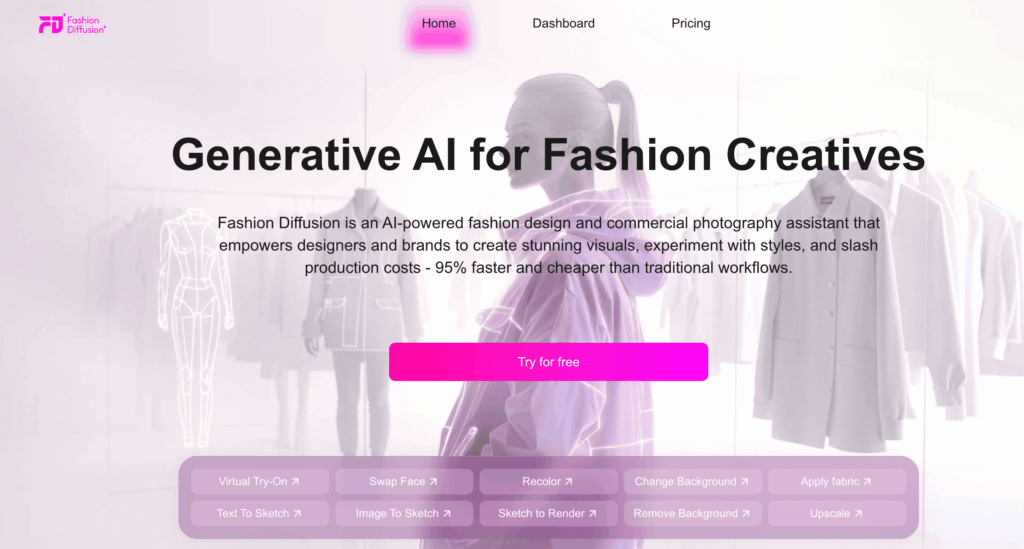
At the center of the next-generation AI design landscape, Fashion Diffusion stands out as a complete creative ecosystem built specifically for fashion designers, brands, and visual creators. It’s not just another AI generator—it’s a platform designed to accelerate every stage of the creative process, from concept to campaign.
Beyond visual generation, Fashion Diffusion also offers:
- Text-to-Sketch & Sketch-to-Render: Turn text prompts or sketches into multiple design variations and photorealistic visuals within seconds.
- AI Image Editing: Built-in tools for recoloring, background removal, model swap, and upscaling—ideal for e-commerce and social visuals.
- Fabric Simulation: Upload fabric patterns or textures and preview realistic materials directly on your AI designs.
- Virtual Try-On: Generate lifelike model shots, switch backgrounds, or test garments on different body types instantly.
- Style Innovation & Fusion: Modify design strength or combine two styles to explore new creative directions effortlessly.
Fashion Diffusion helps creators design faster, visualize better, and reduce production costs—enabling a more efficient and sustainable fashion workflow.
How to Integrate AI into Your Fashion Design Workflow
Embracing AI doesn’t mean abandoning traditional design skills. It’s about blending creativity with technology. Here’s a practical roadmap to help you get started:
Step 1: Define Your Goals
Decide what role AI will play in your process. Are you using it for creative exploration, production efficiency, or marketing visuals? The clearer your goal, the easier it is to choose the right tools.
Step 2: Experiment and Iterate
Start small. Use tools like Fashion Diffusion to generate outfit ideas or test visual directions. Treat AI as a digital sketchbook—a space to brainstorm, not to finalize.
Step 3: Combine AI with Human Creativity
AI can generate ideas, but it’s your artistic vision that gives them meaning. Refine what AI creates. Adjust proportions, play with materials, and infuse emotion into the concept.
Step 4: Train AI on Your Brand Data
Advanced tools allow brands to “teach” AI their visual identity—from color palettes to signature silhouettes. Over time, the system becomes an extension of your creative DNA.
Step 5: Stay Ethical and Transparent
As AI becomes part of fashion storytelling, transparency matters. Disclose when AI is used in imagery or campaigns, and ensure that data sources respect copyright and diversity.
Now Is the Time to Embrace AI in Fashion
The global fashion market is more competitive than ever. Consumers expect innovation, personalization, and sustainability—all at once. Brands that integrate AI early will have a clear advantage: faster creativity, smarter insights, and deeper audience connections.
Whether you’re an established label or an emerging designer, AI fashion design tools like Fashion Diffusion can help you unlock creative freedom. With just a few words or images, you can visualize fresh ideas, explore new aesthetics, and bring your imagination to life.
FAQ
Yes. Modern AI outfit generators like Fashion Diffusion can transform short text prompts into detailed digital outfits within seconds. Designers can use these visuals for ideation, concept testing, or marketing campaigns without needing manual sketches.
Generative AI tools (like Fashion Diffusion) create new design ideas, color palettes, and visual concepts from text or images.
3D simulation tools (like CLO 3D or Browzwear) focus on technical garment construction and virtual fitting.
Many brands combine both to move seamlessly from creative ideation to production.
Absolutely. Many AI fashion design tools are cloud-based and affordable, making them accessible for small teams and solo creators. Tools like Fashion Diffusion and Resleeve.ai let emerging designers produce professional-grade visuals without expensive software or equipment.
No—AI can assist, but not replace, human creativity. It can analyze data and generate visuals, but true fashion design still relies on human intuition, cultural understanding, and artistic storytelling. AI is best viewed as a co-creator, not a competitor.
You can experiment with Fashion Diffusion—an easy-to-use AI fashion design platform that lets you generate and refine digital outfits instantly. It’s ideal for testing ideas, creating campaign visuals, or speeding up your design workflow.